• Home
  • Air Races
  • Aeroplanes
  • Aviators
  • Pioneering Flights
  • Pioneering Women
  • Flying for All
  • Gallery
  • Wings of Peace [Aeromodelling]
  • Contact Me
Details
Hits: 2544

 Click here to see the Newsreel!

Waiting to start:(click to enlarge)

No. 9 (Philip Sayer, Blackburn B2 G-ABWI);     No 21 (Clive Mayers, Comper Swift G-ABJR);

No 16 (Winnie Brown, Avian G-ABED);     No 12 ((Richard Westenra, Moth G-ABJL), and

No 50 (Edgar Percival, Gull G-ABUR)


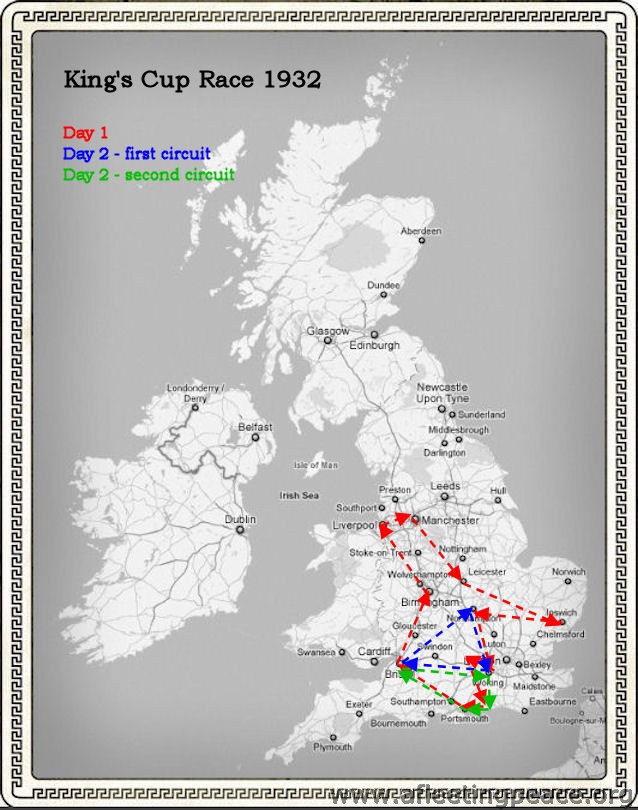
Friday 8th/Saturday 9th July. Brooklands.

Wally Hope's 'easy' third win, after 1927 and 1928.

The Story of the race

Pilot Aircraft   Race No Fate
Mr J F Legard Avro 594 Avian IIIA G-ABPU 1 retired at Leicester
Mr G H Keat Avro 616 Avian IVM G-AATL 2 34th
F/O J W Gillan Blackburn B2 G-ABUW 3 14th
F/O S A Thorn Spartan 3-seater G-ABTR 5 26th
Miss Winifred E Spooner D.H.60G Moth G-AAYL 6 15th
Mr W L Hope D.H.83 Fox Moth G-ABUT 7 winner
Mr J G Ormston Avro 616 Sports Avian G-ABIB 8 disqualified - failed to cross line
F/O P EG Sayer Blackburn B2 G-ABWI 9 22nd
Mr J Grierson D.H.60G Moth G-AAJP 10 23rd
Lt-Cdr C RV Pugh,RN Avro Sports Avian G-ABDN 11 31st
Hon R Westenra D.H. Mcth G-ABJL 12 24th
Mr R TM Clayton Blackburn Bluebird IV G-AACC 14 retired Shoreham - cracked crankcase
Lord M A Douglas-Hamilton D.H. Moth G-AAHP 15 11th
Miss Winifred S Brown Avro 616 Sports Avian G-ABED 16 21st
Air-Comm F E Guest Hawker Tomtit G-AALL 17 retired at start - oil trouble
F/O H RA Edwards Southern Martlet G-AAYZ 18 forced landing near Warrington - cracked fuel tank
Mr H C Mayers Comper Swift G-ABJR 21 disqualified - failed to cross line
Mr M A Lacayo Comper Swift G-ABUU 23 disqualified - missed turning point at Woodford
Mr G E Lowdell Comper Swift G-ABTC 24 16th
Sqn-Ldr J W Woodhouse Avro 631 Cadet G-ABVU 25 17th
Sqn-Ldr W Helmore Hawker Tomtit G-ABII 26 withdrew at Brooklands (not making handicap speed)
Mr W L Runciman D.H.80a Puss Moth G-ABLG 27 3rd
Mr A CS Irwin D.H.80a Puss Moth G-AAVA 28 4th
Mr C L Pashley D.H.80a Puss Moth G-ABLS 30 33rd
Mr Geoffrey R de Havilland D.H.80a Puss Moth G-ABGT 31 8th
Flt-Lt H M Mellor D.H.80a Puss Moth G-ABGX 32 withdrew at Brooklands (Day 2)
Flt-Lt N Comper Comper Swift G-AAZD 33 12th
Lt-Cdr G Rodd, RN D.H.80a Puss Moth G-AAYB 36 7th
Lt Caspar John, RN Avro 625 Avian Monoplane G-AAYW 37 18th
Flt-Lt A PK Hattersley D.H.80a Puss Moth G-ABDF 38 6th
Capt H S Broad D.H.60G Moth Major 'Jason 4' * G-ABVW 39 5th
Mr F R Walker Comper Swift G-AAZC 40 27th
Flt-Lt W EP Johnson D.H.80a Puss Moth G-AAXM 41 29th
Wing-Cmdr J M Robb Comper Swift G-AAZF 42 retired at Birmingham
Flt-Lt E A Healy Avro 616 Avian IVM G-ABME 44 20th
F/O E CT Edwards Arrow Active I G-ABIX 46 10th
F/O H H Leech Arrow Active II G-ABVE 48 19th
Flt-Lt J GD Armour Segrave Meteor G-AAXP 49 retired
Capt E W Percival Percival D1 Gull Four G-ABUR 50 13th
Mr A J Styran Comper Swift G-ABWH 51 9th
Flt-Lt E H Fielden Comper Swift G-ABWW 52 2nd
Capt H A Brown Avro 627 Mailplane G-ABJM 53 36th

* which formerly belonged to Amy Johnson

Starters: 42 (out of 52 entries) Finishers: 31


Did not start:

Mr W H Rhodes-Moorhouse DH.60G Gipsy Moth G-ABOA 4  
      19  
      20  
      22  
Mr W L Hope DH.80A Puss Moth G-AAYD 29  
Miss F J Crossley Comper CLA.7 Swift G-ABUA 34  
      35  
Capt H H Balfour Spartan A24 Mailplane G-ABLI 43  
      45  
      47  
Details
Hits: 3068

The Aviators

Details
Hits: 3187
 Flt-Lt John George Denholm Armour

  Jack', chief test pilot for for Blackburn, later a Wing Commander. Susan Slade's cousin.

Details
Hits: 7220

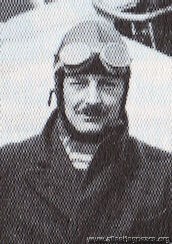
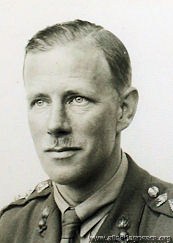
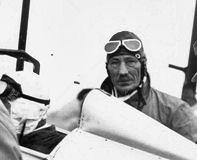
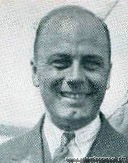
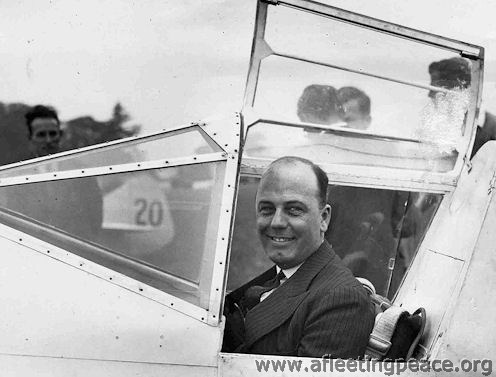
 Capt Hubert Stanford Broad MBE AFC

  photo: 1930, aged 33

b. 18 (or 20) May 1897

shot through the neck in WWI by one of Richtofen's Red Circus pilots; [c.f. Angus Irwin]; second in Schneider 1925, to Jimmy Doolittle.

In 1928, he spent possibly the most boring 24 hours of his life by beating 'all existing figures' for long endurance flights in light aeroplanes (unfortunately there was no official 'record' to beat as such, the FAI not recognising such things). His log makes, um, rivetting reading:

--0--0--0--0--0--0--0--0--0--0--

5:30pm: Hendon

7:40pm: Gloucester

8:30pm: Coffee and sandwiches

11pm: Over Central London, 3,000ft; watched theatre crowds leaving

Midnight to dawn: Remained over Edgeware

2:30am: second meal

4:10am: First signs of dawn

5:10am: Biggin Hill. Saw night bomber in air

...

Noon: Stamford. Very sleepy

4:30pm: Ipswich

--0--0--0--0--0--0--0--0--0--0--

Having trimmed the controls, Hubert settled down and read 3 complete novels 'to relieve the boredom'.

When he finally landed, he he said that he was very stiff with cramp, and promptly went home to sleep. His Moth still had 12 gallons of fuel, so it could have kept going for another 4 1/2 hours...

He was named as co-respondent in Beryl Markham's divorce in 1939.

de Havillands test pilot until 1935 (Bob Waight succeeded him) - broke the world's speed and height records for light aircraft in the original monoplane Tiger Moth, then joined RAE Farnborough; Hawker test pilot post-WWII; died 1975

FLIGHT MARCH 28TH, 1946

 No. 2. CAPT. H. S. BROAD, Senior Production Test Pilot, Hawker Aircraft Co.

 FOR sheer wealth of flying experience it is doubtful whether there is another pilot in the world to equal Hubert Broad. He has flown everything from diminutive single-seaters to multi-engined--bombers, and including a number of out-and-out racing aircraft. His logbooks, of which he has filled some nine or ten, total over7,500 hours' flying time and 182 separate types. These are honest types—not modifications or different mark numbers of the same aircraft. Many of these he has also flown as seaplanes. Broad, at the age of nineteen, learnt to fly at the Hall School of Flying at Hendon in 1915. The aircraft on which he made his first flight (there was no dual, a pupil did straights across the airfield until he felt it was safe to do a circuit)was the single-seater Caudron with35 h.p. Y-type Anzani engine. Believe it or not, with this tiny horsepower the Caudron occasionally was made to stagger into the air with two people on board, but the passenger had to sit on the wing by the side of the nacelle.

 Early Days

 The end of 1915 found Broad in the R.N.A.S. at Eastchurch, and he was on the very first course at Cranwell, which was then a R.N.A.S. establishment rejoicing in the name of H.M.S. Daedalus. His first tour of duty at the front was with No. 3 Squadron at Dunkirk. He was among a number of pilots lent by the R.N.A.S. to the R.F.C. No. 3 Squadron flew Sopwith Pups, and it was while he was on one of these, escorting a bombing raid by 90 h.p. R.A.F.-engined B.E.s, that he was shot through the neck by one of Richtofen's later Goering's—Red Circus pilots.

 On recovery he spent a while as an instructor at Chingford and then went for his second tour of operations with No. 46 Squadron, who flew Sopwith Camels. The end of the 1914-18 war found Broad instructing at the Fighter Pilots' Flying School at Fairlop.

 Peace found him, as it found so many other young fellows ,with the ability to fly aircraft superbly and no other means of making a living. But a good living could be made by joy-riding in the early 1920's. First he joined the Avro Company, who were running joy-riding in a fairly big way, and in 1920 went to the Adiron Lakes in America with two Avro 504 seaplanes. These two aircraft saw their last days in Long Island, where they were completely wrecked by an autumn gale.

 By the next year he was back in England competing in the Aerial Derby air race round London on a Sopwith Camel. He finished 6th.In October, 1921, Broad joined de Havillands. Those who know this great concern now will smile to learn that when it started in those days it consisted entirely of two fabric hangars and a hut at Stag Lane. If memory serves, the capital of the company at that time was £100.

 The D.H. series numbers, which started in the Aircraft Manufacturing Co. Ltd., were carried on in this new firm, and Broad flew every one of the D.H. designs from the D.H.27 to the D.H.90. In the same period he did a lot of test flyingfor other aircraft constructors.

 He did the W.10, Handcross, Hendon, and some others for Handley Pages, the Parnall Pipit and the Saunders A. 10 fighter. On the Gloster Grebe he ran into wing flutter for the first time (this trouble, in those days, was on a par with the compressibility troubles we have now).

 Seaplane testing

 Another big job he did was most of the development work on the Gloster II and III racing seaplanes. Over a period I used to go with him to Felixstowe regularly. As a Press man I was forbidden the precincts of the R.A.F. seaplane station, but there was a perfectly good Great Eastern Railway pier alongside the station. I used to climb over the fence and watch the proceedings from the pier head. Broad nearly lost his life there one day in October,1924. As he was landing the Gloster II a forward strut to the floats collapsed, and the aircraft turned completely over. Mrs. Broad was watching from the shore, and it seemed a very long time before Hubert appeared on the surface.

 In 1925 Hubert Broad flew the Gloster III racing seaplane in the Schneider Trophy contest which was held that year over Chesapeake Bay in America. This was the race in which Henri Biard, flying the SupermarineS.4—the true forerunner of the Spitfire—crashed in the water with wing flutter. Broad finished this race second to Jimmy (now General) Doolittle. That must have been a vintage generation, because many names from that period have found their way into the high-spots of this last war.

With the advent of the D.H. Moth in all its variants, Broad was to be seen performing aerobatics at most flying club meetings and entering many of the races. These included the King's Cup Race, which he won in 1926. He was flying a delightful Cirrus I Moth, which was a study in ivory and red. His average speed over the whole732 miles was 90.4 m.p.h. His piece de resistance in aerobatics was a perfectly formed big loop, the base of which was only some 150ft from the ground. It was a joy to behold, but very dangerous to perform. Broad had sufficient sense to realise this and sufficient courage to stop doing it.

 "Hooked"

 It was during an aerobatic show that Hubert had his closest shave in a life packed with incident. And it was so simple. Flying a D.H. Tiger Moth with no one in the front seat, he did a slow roll—a stunt at which he was a master. The safety belt in the empty cockpit was loosely done up. While the Moth was inverted the belt hung down and, as the aircraft turned the right way up again, the belt came back over the joy-stick. The result was that Broad had only about 1 1/2 inches of stick movement; but, nothing daunted, he made a sort of tail-up, seaplane landing. In this connection it is to be remembered that there were no lovely 2,000-yard runways on which to this sort of thing. In those days there was not a single runway available in Britain; not even for the take-off of over-loaded aircraft for long-distance records!

 Another unhappy moment occurred when he found the tail trim (the incidence of the whole tailplane was adjustable)of a D.H.34 had been connected in reverse. By a good deal of jockeying he managed to get into Northolt. On yet another occasion a careless mechanic left a screwdriver jammed in the chain and sprocket of the rudder actuating gear. This necessitated a down-wind, crosswind, finishing up into-wind landing at Hendon airfield, because that was a bit bigger than Stag Lane.

 One of the prettiest little aircraft he ever flew was the original D.H. Tiger Moth monoplane. This was tailored exactly to fit Broad. Physically he is not of big stature and few other pilots could get into the machine. In the front of the cockpit was a bulkhead which had two holes just large, enough for the feet to be threaded through, and these holes had to be padded with sorbo rubber so that Broad's shins did not get barked while landing and taxying. Springing was almost non-existent. Span was22ft 6in and length only 18ft 7m.

 In August, 1927, on this machine he broke the world's record for light aircraft for both speed and height. For the former the figure was 186.47 m.p.h., he having taken19 min 59 sec to cover the 10 km, and for altitude he reached 20,000ft in just 17 min. A year later he took two more world's records on the D.H. Hound.

 In 1935, after 20 wonderful years of service, he left de Havillands and later did some flying for the Air Registration Board. From here he went to the Royal Aircraft Establishment and finally joined Hawkers to be in charge of all their production testing at Langley. He will be 50 in a matter of a few weeks, yet every day sees him at oxygen height testing Tempest IIs. As he says, he has gone from 35 h.p. in the Anzani to over 3,000 h.p. in the Centaurus and Sabre VI, and from 2 ½ lb/sq ft in the Caudron to 40 lb/sq ft in the Tempest II.


Details
Hits: 3702


 Capt Harry Albert 'Sam' Brown


The 'amiable' ex-instructor for the Lancashire Aero Club; joined Avro after WWI and became their chief test pilot from 1928.

From 1921-26 he was Avro's man in the Spanish Naval Air Service.

Badly injured in 1929 when the first Avocet crashed at Woodford.

 
Details
Hits: 5854


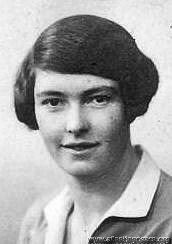
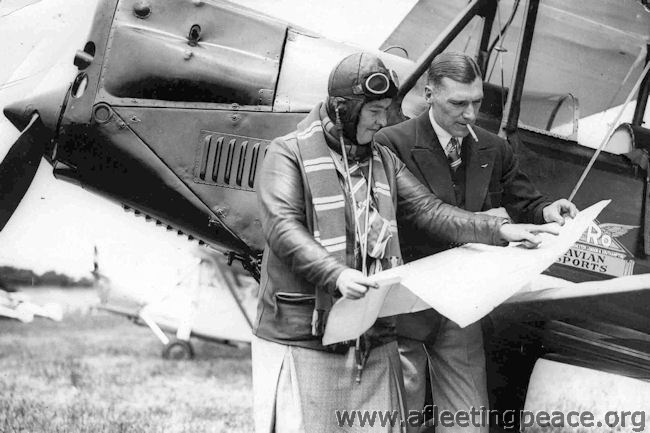
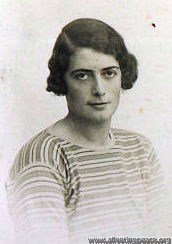
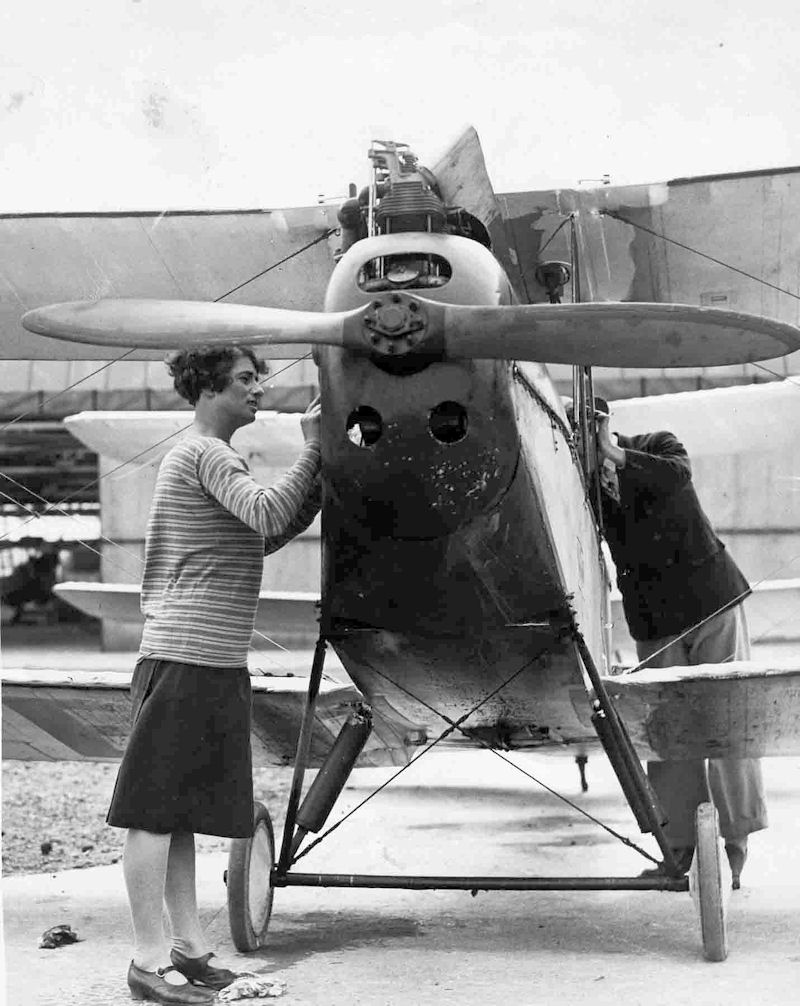
 Miss Winifred Sawley Brown

Royal Aero Club Certificate No. 8091 (6 Apr 1927)


   photo: 1927, aged 28  

 b. 26 November 1899 in Brooklands, Cheshire; her father was director of a firm of butchers.


She said she learnt to roll her own cigarettes at the age of five; expelled from school at age fourteen (for writing 'the headmistress can go to hell' on the toilet wall), she made her first flight in 1919 from Blackpool sands.

  "A Well-known English Pilot" - The Sketch, 1929

First woman to win the King’s Cup (in 1930); well known in Lancashire as a hockey player who kept goal for the county and toured Australia with an English team; also a pretty good golfer, sailor and tennis player.

To see her being thoroughly embarrassed by her reception back at the Lancs Aero Club after winning the King's Cup, and to hear her say “Thank you for this welcome, it’s awfully good of you and I’m awfully happy to be back again in Lancashire, at the aerodrome where Captain Brown taught me to fly…. I’m delighted to have won the race and, well, thank you all very very much, I can’t say any more”, see here

Her son, Tony, b. 11 December 1940 in Angelsey, is "loved and remembered by millions as slippery Adam Chance in Crossroads".

She owned:

the 1928 Avro 594 Avian III, G-EBVZ - which her father bought for £500 - in which she won the King's Cup in 1930, then

a 1930 Avro 616 Sports Avian, G-ABED.

'Win' died in July 1984 in Hove, Sussex.

And you can now get a proper biography, entitled "WINIFRED BROWN: Britain's Adventure Girl No. 1", written by King's Lynn's most famous living author, Geoff Meggitt.

See www.pitchpole.co.uk for details!

b 26 November 1899 in Brooklands, Cheshire; her father was director of a firm of butchers.

Learnt to fly in 1926, but in 1928 was the pilot in a horrific accident when she was duped into a publicity stunt by Walter Browning, the 'Dancing Airman', who told her a film had to be delivered urgently, and persuaded to land her Avian in a field. She was surprised to see a crowd of people, realised she wasn't going to stop in time and tried to take off again, but hit the crowd standing near a wall; a 10-year old boy was killed, several persons injured, and "many women fainted". It turned out that the 'urgent film' never existed, just an empty box. She was exonerated of any blame.

First woman to win the King’s Cup, in 1930. She became an instant star across the world, especially in her home city of Salford. Invited to the 1930 Historical Pageant at Buile Hill Park shortly after the race, crowds chanted for a speech to be made. Winifred said “This is really wonderful of you all, I am very glad to belong to Salford” which prompted one audience member to start a sing along of ‘for she’s a jolly good flyer’. The Mayor of Salford congratulated Winifred on behalf of the people, and joked “No man begrudges you your honour and you have put us all back in our place”.

Before the Race, she was "well known in Lancashire as a hockey player who keeps goal for the county and has toured Australia with an English team".

One of the guests of honour at the Ladies Night dinner of the Press Club in December 1930; the chairman reckoned that "Women had forced their way into the columns of the Press, and now they seemed to be on the way to monopolizing them".

She was still an active ice hockey player in 1933, flying herself from Manchester to London to take part in the Sheridan Cup, where she kept goal for the "Queen's Ladies". She was also a pretty good golfer; she and her partner Mrs Brooks got to the last 8 of the Ladies' Northern Foursomes at Leeds in 1938.

Later sailed from North Wales to Spitsbergen in her 45-foot yawl Perula. During WWII, Chief Coxswain in the Marine Department of Saunders Roe.

In 1940 she gave birth to a son, Anthony, after it was revealed she had "secretly married her long time adventure companion Ron Adams" (although I'm not sure what was so secret about it).


She attended the 1950 King's Cup Race, but was "horrified  ... I thought sadly of Bert Hinkler, Cobham, Barnard, Hubert Broad and Wally Hope."

'Win' died in July 1984 in Hove, Sussex.

Winifred Brown was born [26 November] 1899 in Brooklands, Cheshire. She moved to Salford at an early age and went on to attend ‘Bella Vista’, Broughton High School for Girls. Winifred’s father, Mr Sawley Brown, was director of Messrs. James S. Brown & Sons, a firm of butchers.

Winifred was a natural sportswoman, and achieved great success in flying when she became the first woman to join the Lancashire Aero Club in 1926 and the first woman in the region to qualify for a pilot’s licence in April 1927. By March 1928 Winifred was recruited to the rank of a private owner member, and that same year she won the club’s Rodman Trophy.

By the 1930 King’s Cup Air Race, a 750mile race around England, Winifred Brown was an experienced pilot, although she had never flown such a long distance. In the pre-race articles that appeared in Flight magazine, on June 13 1930,Winifred’s entry was not taken seriously, mentioned with six other pilots of the ‘fairer sex’ only briefly. Winifred flew an Avro Avian with a Cirrus III engine with her co-pilot, and later husband, John Ron Adams. The Air Race was full of excitement, after starting the race at Hanworth, London. By the time she reached Barton Aerodrome, Winifred was in third position and the large crowds roared with excitement. The final finish was at Newcastle, by which time she’d run away with the lead. There was a dramatic finish when Winifred spotted a large aircraft behind them. Believing it to be a competitor and determined not to be beaten to the finish line, the Avian was pushed to speeds of 160 miles per hour! Afterwards a mechanic told the Salford Reporter that this speed ‘was courting disaster’. By pushing her Avian to the limits Winifred beat her male contemporaries, including Flight Lieutenant Waghorn, winner of the prestigious Schneider Cup.

As the first woman to win the King’s Cup, Winifred became an instant star across the world, especially in her home city of Salford. Invited to the 1930 Historical Pageant at Buile Hill Park shortly after the race, crowds chanted for a speech to be made. Winifred said “This is really wonderful of you all, I am very glad to belong to Salford” which prompted one audience member to start a sing along of ‘for she’s a jolly good flyer’. The Mayor of Salford, Samuel Finburgh, congratulated Winifred on behalf of the people, and joked “No man begrudges you your honour and you have put us all back in our place”(Salford Reporter 11 July 1930).

Winifred’s later adventures in the 1930s went beyond Britain, this time sailing rather than flying from North Wales to Spitsbergen in her 45-foot yawl Perula. During the Second World War, Winifred worked as Chief Coxswain in the Marine Department of Saunders Roe, the flying boat constructors in Beaumaris. Winifred worked with a fleet of R.A.F. craft with all-male crews, she met Catalinas from Bermuda, landed and embarked crews and towed aircraft.

In 1940 she gave birth to a son, Anthony Sawley Adams, after it was revealed she had secretly married her long time adventure companion Ron Adams.

With thanks to John B. Coxon and Tony Adams

http://www.salford.gov.uk/d/LTL26v3final.pdf

In 1950, Winnie wrote this lovely article for 'Flight':

POST-WAR AIR RACING - is Something Missing?

A Pre-war Winner Asks Some Pertinent Questions

By WINIFRED BROWN

As something "rather different" in post-war air races, the Daily Express  "International South Coast Race" on September 16th seems likely to be watched with interest, especially by "the forgotten pioneers of long ago" - in which category a South African magazine recently included me!

For some time we have been asking ourselves " What has gone wrong - air racing or we old pilots?" Has the sport really lost its thrill and popularity, or have we merely become the club bores who stand at a bar counter and say, between beers, "Things aren't what they were"?

I have been thinking about these questions for several weeks - ever since, in fact, I set off, in excited anticipation and an Austin Seven - to see this year's King's Cup Race. The Wolverhampton Aero Club had very kindly invited me - "Just to show them you are still in the land of the living, Win?" chuckled John Bill over the telephone, for the previous year the B.B.C. had coupled my name with the type of wings that go with a harp! It was 20 years since I had won the King's Cup and 19 years since I have even seen an air race. I had a shock coming to me!

When asked if I were flying, I laughed and replied ungrammatically, "What, me! I'm used to 105 m.p.h.,not 501." And as my little car proceeded at a sedate 40m.p.h. my mind went back 20 years. Who would be there? Tommy Rose, Jimmy Jeffs, Robin Cazalet, "Lamps"? What fun it would be to see them all again!

On arrival at the Star and Garter I rushed to look at the hotel register... I didn't recognize a single name! They must still be in the bar... we had always lingered... they would come later; so, casting respectability to the wind, I ignored my married name and wrote " Win Brown and son."

That night there was a R.A.F.A. dance - to meet the "famous pilots"! The dancing was popular enough, but we were not; when we went on the stage the room practically emptied - the dancers had probably done far more flying than we had!

Still there was a nice bar upstairs, and I talked with interest to the 1950 pilots. "Do you have flying pageants these days?" I asked a young man. For a moment he looked puzzled, then replied "Yes, but we call them 'air rallies'". When I flew in 1930 we had a 750-mile course. Do you like these short circuits? " "Oh yes! It's a better test of flying—none of this navigation stuff enters into it. '

I thought sadly of Bert Hinkler, Cobham, Barnard, Hubert Broad and Wally Hope. That night I went to bed at 11.30 - if there was a party I didn't find it!

Next day I got to the airfield early. I looked and blinked. Was I back in 1930? Where were these modern super aircraft? I felt I could have got into almost any one of the competing machines, and flown as I used to do; but my son, aged nine, was thrilled as I took him round. It was then the Press descended on us - "That's right,sonny - smile up at your grannie!'' My expression was such that the pictures did not appear, but fortunately the bar tent opened and Jack Cantrill, who had given me my first flying lesson in 1925, assisted me to recover.

Then a few old faces appeared, but we all sadly agreed that "things ain't wot they was." As for the race itself - well, it sounded fine on the radio but, with no rudeness intended, I would not describe Hawk Trainers and Austers "screaming" round anything. Princess Margaret's Hurricane gave us a thrill and it was beautifully handled by Townsend, but the two Spits that I hadrelied on to impress my son promptly took off and got lost - so perhaps there is something in this ''navigation stuff" after all! One we never saw again, but the other obligingly returned, much to the delight of my small son, and the spectators - but probably less so to the owner of the aircraft whose tail it knocked clean off.

But what horrifies me about this race - and, for that matter, present-day air racing in general - is that the slide-rule experts, secreted with Charles Gardiner in glass towers, seem reasonably able to forecast the result after one lap! In the King's Cup they were about 60 yards out, and in the two Newcastle races a few weeks later it seems from Flight's report that the ultimate winners appeared unbeatable almost from the outset.

Where is the sport, the fight, the fun of the thing? It seems to me that if you haven't beaten the handicappers before you start you might just as well stay in the bar. On a long circuit a race was never lost until it was won. Engines could pack up in sight of home; flimsy racing wheels could buckle on a careless landing; you might run into cloud or fog and fail to find that white cross in the field; but no matter what happened there was always home - the others might be faring worse. To beat the handicappers was a decided help, but only the beginning of a long story.

After this year's King's Cup I scanned the newspapers, but gone were the old headlines. The little publicity there was went to the tragic accident rather than to Edward Day. I wondered vaguely if a victory for Princess Margaret would have received more publicity, but I doubt it - my papers were full of the footballers who received a free trip to South America, £25 each and the offer of some £175 a month, and returned highly incensed because a hair-cut cost 7s and the people carried rifles!

So good for British prestige, and obviously so much more important than a few men and women who risk their neck for British aviation, a possible prize of £150 and a replica of the Cup. I did risk my neck for about £1,000 in 1930, and in those days the cup was won outright.

What has caused this lack of interest on the part of the Press and public? Has flying become too common? But, for that matter, what could be more common than football and race-horses, sports which still hold the crowds? Perhaps it is the effect of the war - petrol only just off the ration, money short, private owners and aero clubs unable to afford the high-powered aircraft we now scarcely glance at as they do, literally, scream through the sky.

Presumably with the industry in a transition stage pending large-scale production of military jet aircraft, and because of present-day-economic conditions, the trade cannot give the support it did to racing. For this reason one must admire the present-day private owner. Gone are the days of dual at £1 an hour, free petrol, a loaned engine, and perhaps even a free aircraft. To-day one can hardly afford to patronize the bar tent!

My small son was all for presenting the King's Cup to Cole and his Comper Swift. ''That little one has done best, Win - t has gone all that way against the big ones." Out of the mouths of babes and sucklings.... Would the old Circuit of Britain again arouse public interest? Personally, I think it would. Some 15,000 people were present at Wolverhampton this year, but in 1930 similar, if not larger, crowds assembled at each of the controls at London, Bristol, Manchester, Newcastle and Hull, not to mention the turning-points at Southampton, Birmingham,Liverpool, Leeds and Leicester. The King's Cup race belonged to the country as a whole and not just to one area.

But there is another point, and an important one. The rot started to set in way back in 1931, when new King's Cup regulations caused the entries to drop from 101 to 41. Restrictions! They are ruining our country to-day. It seems to be that the South Coast Race is, in some degree, a return to old conditions, and that if it is successful it may influence next year's King's Cup. I hope so, for personally I would like to see a grand and glorious free for all - Maggies to Meteors on the old circuit of Britain.

''What else would you do, Win?" asked one of the old timers as we stood discussing the matter in the bar. "I'd have bookies under nice, coloured umbrellas - but I'd keep them away from the slide-rule experts!" And I suppose you'd have better prizes and bigger bar tents? "Sure!" I laughed. "Well," said an old pilot, slowly, "something has got to be done; the King's Cup to-day is no different to the little races we used to take part in every Saturday at the old pageants." "Rallies, dear, rallies," I corrected.

So we all had another beer, and my small son, waiting outside, began to take a dim view of aviation.


Details
Hits: 2858

 Mr Roscoe TM Clayton

 in 1931, when a Captain in the RE, at RAE Farnborough, aged 31

Not sure about this - he's the only R Clayton I could find


Details
Hits: 4058

Flt-Lt Nicholas Comper

  in 1916, aged 19


lecturer at the Cranwell Engineering Laboratory, ex Cambridge University.

Designer of the Comper Swift; died in 1939 after a practical joke went wrong

Details
Hits: 3918

 Mr Geoffrey Raul de Havilland

  1936

Geoffrey Junior, aka 'Young D.H.' born in 1910 and learnt to fly at Stag Lane at a tender age. Took over as chief test pilot at de Havillands when Bob Waight was killed.

Second Brit to fly a jet-propelled aircraft on its first flight, the Vampire in 1943. Killed when the second DH108 Swallow broke up and crashed in the Thames estuary in 1946.

Flight 18th April 1946

As a test pilot young D.H., as he is universally called,has not an exceptionally long history. He took over the chief test pilot's position in October, 1937, when R. J. Waight unfortunately lost his life on the T.K.4. Being, however, the son of his illustrious father, Sir Geoffrey de Havilland, who designed, built and test flew his own aircraft from 1911 onwards, young Geoffrey can be said to have been ''in the industry'' from the very cradle. It is not generally known that Sir Geoffrey took his R.Ae.C. ticket No. 53 in February, 1911, on the second machine of his own design and construction, and that he has made many of the first flights on new D.H. types right up to the Moth Minor in 1938.

Geoffrey's first flight is lost in the dim past, but certain it is that at the tender age of six he was flying with father at Hendon in a D.H. 6 (also known as the Clutching Hand). When 18 years of age he left school and came to de Havillands as a premium apprentice for 4 years and learnt to fly on Moths at the firm's reserve training school. After spending two years in the drawing office—much of the time being spent looking out of the windows envying the pilots—he joined the Air Operating Company, who were doing a lot of air survey work in South Africa. This, however, gave him but very little flying, and at the end of six months, he came back to England to become a flying instructor to the D.H. Technical School. The aircraft were wooden Moths built by the students. In 1929 he took his B licence; a very simple business in those days. Some 20 or 30 hours' solo flying, a little cross-country work, a simple "Met" exam, and about one hour's night flying at Croydon was sufficient to qualify.

In 1934 Capt. Hubert Broad was chief test pilot of de Havillands, and Bob Waight looked after the production side. There was so much work, however, that Geoffrey was given the opportunity to lend a hand testing Tiger Moths, Dragons, Rapides, Express Air Liners, and Hornet Moths.

Broad left the company in 1935 and Waight took over, starting, with the Dragonfly and later the Albatross. It was during the period when the prototype Albatross was going through its development flying that Waight lost his life, and de Havilland took over as chief test pilot. Nobody could have taken on a more interesting or more complex job because the Albatross was completely experimental from tip to tail. Engines were new, construction was new, and the layout was extremely advanced.

He had a curious experience on the Albatross. While its strength was ample for all flying loads, some unfortunate drilling had weakened the fuselage under ground loads, and shortly after landing from a test flight the machine broke in halves on the ground.

When war broke out lie was busy testing Oxfords and Flamingoes, but when things became desperate at the time of the Battle of Britain, de Havillands did a big job doing emergency repairs to shot-up Hurricanes.

Dick Reynell of Hawkers came over and gave Geoffrey the "know how" on Hurricanes. A little later Dick went out on operations with his old squadron (No. 43) and was, unfortunately, shot down.' He was an excellent test pilot and a gallant gentleman.

Improvised Runway

Geoffrey flew the first Mosquito at Hatfield on November 21st, 1940, but he is more proud of the first flight of the prototype Mosquito fighter. This was built at a dispersal factory with no airfield. To save some six week's wasted time in transport and re-erection at Hatfield, Geoffrey used local fields by having bridges built over ditches to give him a 450yd run for take-off, and then flew the fighter to Hatfield.

He is, of course, one of the only two men in Britain to have made first flights on jet-propelled aircraft. The Vampire was flown for the first time on September 21st, 1943, but Geoffrey had already flown the Gloster E.28 at Farnborough. The first airing of the Vampire proved it to be a tribute to the D.H. design and aerodynamics staff, as it behaved almost exactly as they had forecast. There was, however, somewhat of an aileron overbalance which limited the speed to 250 m.p.h. and a rather severe tip stall.

Geoffrey de Havilland had made a number of investigation flights on Mosquitoes for compressibility effects, but on the Vampire he has done extensive work. The Vampire, under the effects of compressibility, executes a series of sudden high-speed stalls: the path of the machine is similar to an artist's conception of a streak of lightning, and unless the pilot is strapped-in tightly he is likely to be knocked out by hitting the cockpit roof.

Geoffrey, with another pilot, has flown the Vampire in tight formation at over 500 m.p.h., and to investigate snaking, which is causing considerable trouble on most jet aircraft, he has flown the Vampire with rudder locked.

Like most of the test pilots, he is living on borrowed time, they having at some stage of their careers had close shaves. Strangely enough, Geoffrey's nearest go was on about the mildest type he ever flew. It was the first production Moth Minor. The prototype had completed its spinning tests, and the same tests on the production model appeared to be only a matter of form. He was flying with John Cunningham (now Group Capt., D.S.O.,D.F.C., and test pilot for the D.H. engine division) at the time. The Minor was put into a spin at 5-6,oooft, but after it had failed to come out in five turns and the engine had stopped, a panic decision was made to abandon ship.

Test-flying a Hurricane, too, almost saw him off. This particular aircraft had had a gruelling time in the Battle of Britain, and the whole canopy came off at 4,000ft.hitting him in the face as it blew backwards. At first blind through the amount of blood in his eyes, he flew more by instinct than anything else until he found he could get a little relief by holding his face close to the instrument board. The blood dispersed a little and he was able to land through what appeared to be a thick yellow haze. He wears the scars across his nose to this day, and there was a terrible moment during that flight when he thought he was really blind.

On another occasion the oxygen bottle contained only compressed air, and the effects from this were at first blamed on the previous night's party.

At the other end of the scale was the test of the T.K.5, a tail-first aircraft built by the technical school. Impecunious at the time, Geoffrey had already mortgaged the bonus for the first flight. Imagine his consternation then when, after roaring the whole length of Hatfield airfield, the machine showed no sign of lifting. The forward elevator was ineffective. The T.K.5 never did fly and was finally abandoned.

In the days of peace before the war Geoffrey de Havilland was to be seen at all the air meetings and twice finished 4th in the King's Cup Race flying the TK1 and TK2.


Details
Hits: 3321
 F/O (later Flt-Lt, Sqn Ldr) Edward Cecil Theodore Edwards


  1931, aged 26


Cecil, brother of Hugh. From Kensington, London. Sometimes known as "Sphinx".

M.A.(Oxon); rowing blue in 1925 and 1926 (when he was the "best man in the crew, as always"); the first member of the Oxford Air Squadron to qualify as a pilot.

Flew, with Winifred Spooner, a Desoutter in an attempt to reach Cape Town in 1930, but they had to ditch in the sea off Italy, and swim about a mile to shore.

Winner of the King's Cup in 1931; here is his "Competitor's Armband" from the race:

cecil edwards kings cup armband 1931 

Apparently, after the race, "a triumphant Cecil 'Sphinx' Edwards was invited to Sir Robert MacAlpine's house to celebrate the win (Sir Robert had lent Sphinx his Bluebird aeroplane). On leaving the party, Sir Robert grabbed the trophy, said "Well done Edwards" and that is the last that Sphinx or the family would ever see of the trophy. It is now awarded at Henley as The Prince of Wales Challenge Cup after mysteriously being donated to Henley by an antique shop owner."

with many thanks to Gavin Jamieson, who found the armband among his family's archives


Killed in WWII: 31st August 1940, when a Wing Commander (pilot) 53 Sqn RAF; buried in Rotterdam, Holland.


Details
Hits: 3159
 P/O (later F/O, Flt-Lt) Hugh Robert Arthur Edwards


  1929, aged 23


'Jumbo', the famous Oxford rowing coach, younger brother of Cecil


His grand-daughter's husband Gavin has written Jumbo's story, in four parts, starting here:

https://heartheboatsing.com/2020/02/17/jumbo-edwards-oarsman-coach-and-raf-pilot-part-i/


Details
Hits: 3047
 Flt-Lt (Sir) Edward Hedley Fielden KCVO CB DFC AFC


'Mouse', b. 1903. Prince of Wales' (i.e. Edward VII's) pilot, later Captain of the King's (and Queen's) Flights until 1962.

DFC, 1943: "This officer has flown on various operational missions, some of a most hazardous nature. He has displayed a high standard of operational efficiency, setting an example which has contributed materially to the high morale of the air crews under his command. His great organising ability has proved a valuable asset.”

Edward Fielden (RAF officer) - Wikipedia

d. 1976


Details
Hits: 3395
 F/O John Woodburn Gillan DFC and bar, AFC 

 mini_-_j_w_gillan.jpg


b c1907. From Edinburgh.

Established a world's land plane record in an RAF Hawker Hurricane on February 10, 1938; flying "blind", he covered the 327 miles from Edinburgh to London in 48 minutes, an average speed of 408.75mph. This feat earned him the nickname of 'Downwind Gillan'.

AFC in January 1939 as Sqn Ldr.

Killed in WWII: 29th August 1941, when a Wing Commander (pilot) RAF; buried Dunkirk.

Details
Hits: 3235
  Mr John Grierson


Having joined the RAF but then regretted it, John tried to resign in 1931. However, his resignation being refused, he smuggled himself from where he was stationed in India into his D.H.60G Moth 'Rouge et Noir' (which he had bought from Glen Kidston, and which was painted red one side and - you guessed it - black the other), and flew home, making long hops to avoid R.A.F. aerodromes. "The business was settled in the end without a courtmartial, though not without a period of open arrest".

Next came a solo flight of 9,000 miles round Russia, and then an abortive attempt on the Arctic air route in Rouge et Noir equipped as a seaplane; a nose-over into a choppy sea at Reykjavik put paid to the attempt.

Rebuilt, and fitted with wheels and ski equipment, the little Moth finally carried Mr. Grierson round Eastern Europe in mid-winter.

Then, in 1934, he made a successful westbound Atlantic flight via Iceland in his de Havilland Fox Moth 'Robert Bruce'.

Transferred to Hawker and then Gloster as a test pilot; he was one of four pilots to fly Britain's first jet aircraft, the Gloster/ Whittle E.28/39.

Wing commander after WWII, then a Member of the Council of the Royal Geographical Society.

d. 21 May 1977 in Washington DC, aged 68. He was addressing a symposium at the Smithsonian's Air and Space Museum to mark the 50th anniversary of Lindbergh's transatlantic flight when he was taken ill; he died a few hours later in hospital.


Details
Hits: 3323
  Capt (later Sqn-Ldr, Air-Comm) the Hon Frederick Edward Guest CBE DSO MP

 mini_-_hon_f_e_guest.jpg 1929, aged 54


 freddie_guest.jpg


b. 14 June 1875 in London.

'Freddie', Winston Churchill's cousin; Diana's (q.v.) father; Liberal then Conservative politician (Secretary of State for Air in 1920-22, despite the fact that, at the time, he knew "very little about aviation, but it is to his credit that he does not pretend to know").

Died 28 April 1937.


Details
Hits: 3079
  Flt-Lt Arthur Patrick Kilvington Hattersley

    Daily News (London) - Friday 20 November 1936


RAF from Feb 1918

"RECORD FLIGHT FROM FRANCE A record flight from Lille (France) London was made last night by British Continental Airways when an air liner their regular dally service completed the 160 miles' Journey In one hour. The machine was piloted by Chief Pilot Captain A. P. K. Hattersley and carried passengers and luggage. Captain Hattersley reported visibility to quite exceptional, and said that the evening light the coast England could be clearly seen before leaving the French side." Yorkshire Post and Leeds Intelligencer - Wednesday 20 May 1936


d. 19 Nov 1936 in British Airways (ex-KLM) Fokker F12 G-AEOT, which crashed near Gatwick Airport - "The pilot, Flt Lt A.P.K. Hattersley, was very experienced and had about 5,000 hours logged - he had, however, only done 2 hours in a Fokker F12 prior to the accident."

"Captain Arthur Patrick Kilvington Hattersley was 36 years old and had been flying since the age of 17. He was a flight lieutenant in the R.A.F. during the war. In 1923 he joined the South African Air Force and returned to England in 1926, becoming an R.A.F. instructor. Hattersley became one of the chief pilots of British Continental Airways, which later merged into British Airways. "


Details
Hits: 2934
  Flt-Lt Lewin Edward Alton Healy


 RAF Cranwell, 1922. Twice mentioned in dispatches.


Details
Hits: 3076
  Sqn-Ldr (Air Commodore) William Helmore


 RAeC Certificate 9698 (1931)

William Helmore - Wikipedia


Details
Hits: 3405
  Capt Walter Laurence 'Wally' Hope

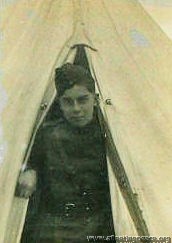
  1917, when a 2nd Lieut in the RFC, aged 20

  1928, aged 31


Technical director of Air Freight.

b. 9 Nov 1897 in Walton, Liverpool

Aged 18, and described as a "trick-cyclist", he was summoned in 1915 for committing a breach of the Realms Act by taking a photograph of one of his Majesty's ships at Barrow; he pleaded not guilty, admitted that he was carrying a camera, and was fined £5.

A close friend of Bert Hinkler, he made an extensive search over the Alps at his own expense when Bert went missing on his fatal flight in 1934, but then sued the Daily Mirror when they published their hair-raising account of his exploits, "Captain Hope's Ordeal in the Alps". He said there was "not one word of truth in it."

 m. 1920 Marjory [Stone]

Three-time winner of the King's Cup Race (1927, 1928 and 1932)

In the 1926 King's Cup race, "he had to descend at Oxford while racing for home in the last lap with a small “airlock" in his petrol pipe, which effectually put his tiny Moth machine out of the running. He landed in a small field - so small that he found it impossible take off again when his minor trouble had been rectified without pushing his  plane through three fields to a broader stretch of country, where he could rise. By this time it was so late that he decided that would abandon the race and go on at his leisure to Hendon.

Interviewed at his home in Hendon yesterday, Mr. Hope said: “The only thing that I am really disappointed about is that I feel sure that if this trifling mishap had not occurred I should most certainly have won. For three laps I was racing neck and neck with Captain Broad, with an aggregate speed equal to his - between 90 and 91 m.p.h." Daily Herald

At the end of the 1928 race, "Thinking all was over he proceeded to loop and stunt before landing, and having landed switched on his well known winning smile. Suddenly there was a terrific hooting, and Sir Francis McClean in his white Rolls-Royce came tearing across to tell Hope he had not crossed the finishing line... Within 30 seconds Hope was in the air again, discovered the finishing line, landed, and again switched on the winning smile fortissimo." C G Grey

Entered for the MacRobertson Race in 1934 (No 24) but didn't take part in the end.

 m. 1954 Hilda L [Stone or Hunt]

d. Oct 1979 - Isle of Wight


Details
Hits: 3096
  Mr Angus Charles Stuart Irwin

  1916, when a 2nd Lieut, Royal Irish Rifles, aged 18

  1931


born in Motihari, India; educated at Marlborough and Sandhurst. RFC in WWI: 2 victories, but was then shot in the foot by a member of Richtoven's squadron.

Post-WWI, was "engaged in the estate business" (whatever that means).


Details
Hits: 3088
  Lieut Caspar John, RN

  1930, aged 27


Son of Augustus (the artist and well-known pacifist); mother died when he was 3; later became Admiral of the entire Fleet, which must have gone down well with his dad.

d. 1984.


Details
Hits: 2946
  Flt-Lt Wiliam Evelyn Patrick Johnson


 b. 7 Apr 1902

Filed several patents when working for Power Jets Ltd, e.g. "A means for injecting liquid coolant into the gas flow path through the turbine in a direction initially transversely to the median thereof whereby the gas flow deflects the coolant, still in liquid form, on to the region of the leading edges of the turbine rotor blades."

d. 1976 -  Kensington, Greater London


Details
Hits: 2727
  Mr G H Keat


 ??


Details
Hits: 2934
  Mr Mark Anthony Lacayo


photo: 1925, aged 26


b. Marcos Antonio in Altrincham, Cheshire on 17th April 1898; a 'shipper', but also Comper's Sales Manager.

Flt-Lt in WWII; d.  11th Feb 1946 in a flying accident in a Mosquito, and is buried near Litchfield.


Details
Hits: 3535
  P/O (later F/O, Flt Lt) Haliburton Hume Leech


photo: 1926, aged 18


Haliburton H Leech was born 16 Apr 1908, in Wylam-on-Tyne, Northumberland. He competed in 6 King’s Cup races – every year from 1929 to 1934.

His father, Dr. (later Sir) Joseph William Leech, J. P., was the Sheriff of Newcastle-upon-Tyne, and later its M.P.; at the time they lived in Wylam Hall, which according to English Heritage is a vast “rambling house built in the 15th century with 18th-19th century alterations, since divided into 3 apartments”. Haliburton was the youngest of 3 sons.

He went to Harrow from 1922 to 1925, then gained his Royal Aero Club Certificate (No 7993) at Cramlington with the Newcastle-on-Tyne Aero Club, flying a D.H. Moth, on the 10 Apr 1926.
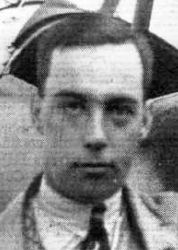
h_h_leech_1931.jpg

In 1931, Flight described him thus:

“… a well-known figure at flying meetings, as his aerobatic demonstrations in the Martlet are always amongst the prettiest to be seen.

He entered Cranwell as a cadet in 1925, finally leaving there and being posted to Tangmere in 1927.  

He was promoted to Flying Officer in July 1929, and in 1930 went to the Royal Aircraft Establishment at Farnborough, and has since been engaged on a great deal of test work, flying a large variety of machines.

This year he was selected as one of the members to join the High Speed Flight at Felixstowe preparatory to receiving his training to take part in the forthcoming Schneider Trophy Race, but, much to his disappointment, he was later sent back to Farnborough, as it was found that there were too many pilots in the flight.

F/O. Leech has raced on numerous occasions in light aircraft, and is always consistent.”


However, during one such aerobatic demonstration, one cynic pointed out that "After all it does not matter if he does crash, as his father is a doctor!”

In 1932, he piloted the Royal Aircraft Establishment’s Scarab (a parasol-wing modification of the D.H. 53 Humming Bird) on its first flight.

He was posted to the School of Naval Co-operation, Lee-on-the-Solent, on the 1st March 1934, then (as a Flight Lieutentant)  to No. 824 (F.S.R.) Squadron, Upavon, on the 8th October 1934.

Here he is (with a bandaged left hand) with Leslie Runciman, 'C.C', and Connie Leathart, amongst others

He was best man at his elder brother Basil's wedding to Grace Luckham in September 1937, then married Miss Ruth Janet Chernocke Elliott (the younger daughter of Mr and Mrs A E Elliott of Little Hill, Bromeswell, Woodbridge) at Eyke Church, Suffolk on 9th October 1937. The happy couple then left by air, from Martlesham, 'for abroad'.

He retired from the RAF in September 1938 due to ill-health, and died 5th May 1939, in St Bartholomews Hospital, when he was only 31.

Unusually, 'Flight Magazine', who carried innumerable references to his flying displays, carried no news of his death - normally they would have produced a short obituary of someone so well-known in aviation circles.

His gravestone (with thanks to the Gravestone Photographic Resource) is in Eyke Church:

 "To the beloved and wonderful memory of Haliburton Hume Leech".

His father, Sir Joseph, died a year later.

Ruth married a Mr Foster in 1940 and died in 1986 in Ipswich; she was referred to as 'Ruth Janet C Lady Foster'.


He competed in loads of air pageants and races throughout the 30s, including:

- The Kingston-upon-Hull Air Race, at the Hull Air Pageant  which was held to celebrate the opening of the Hull Aero Club clubhouse in April 1930.

The 7 entrants were Leech (flying "Miss Perry's D.H. Moth G-AASG" *); Winnie Brown flying her Avian G-EBVZ; Winifred Spooner in her D.H. Moth G-AALK; Ivor Thompson (D.H. Moth G-AACL); Alfred Jackaman (D.H. Moth G-AADX); Robert Cazalet in his Westland Widgeon G-EBRM, and Capt G Thorne in Avro Avian G-AAHJ.

Leech finished first but was disqualified for ‘not turning at one of the marks’.
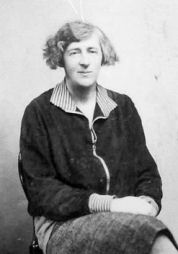
mini_-_violet_perry.jpg

* Miss Violet Perry (seen here), who flew at the Berks Bucks and Oxon Club, is not listed as the owner of G-AASG, though; it apparently belonged to 'Miss M Shillington'.

September 25, 1932 saw him coming 3rd in the Yorkshire Trophy Race - "175 and a half miles over two triangular circuits" in the Arrow Active, behind Edgar Percival in a Gull, and Col. Louis Arbon Strange in his Spartan.

Later, "F/O. Leech gave one of his thrilling, if not hair-raising, displays on the Arrow Active."


 In July 1933 he was in the Cinque Ports Wakelfield Cup Race; coming 3rd in a Pobjoy-engined Comper Swift.

A few weeks later (12 August 1933), he put up the fastest time in the London to Newcastle Race in Richard Shuttleworth's Gypsy-engined Comper Swift G-ABWW, but ended up 5th (of 10) on handicap. He received a cheque for £10 for his effort; the 166.09 mph was "the highest registered speed obtained on any British light aircraft" at the time.

In July 1937, he was listed as one of 15 competitors in the Devon Air Race (which also included Alex Henshaw, Connie Leathart, Tommy Rose and Geoffrey de Havilland) but withdrew before the start.


In the King’s Cup:

1 - G-EAUM (1929)

This aircraft was a real-old-timer, an Avro 534 ‘Baby’, first registered in July 1920. Squadron Leader Harold Payn had raced it in 1922, and R. A. Whitehead (who sold it to Leech) in 1928. Leech, in turn, sold the aircraft to H.R.A. Edwards, and it was finally withdrawn from use in November 1934.

2 - G-AALK (1930)

This D.H.60G Gipsy Moth was almost new (first registered August 1929), and belonged to the Household Brigade Flying Club at Hanworth. It was flown by Squadron Leader the Hon. Frederick E Guest in the 1931 race, then went to Wrightson Air Hire, but crashed at Shackend Railway Station near Hawick in April 1937.

3 - G-ABIF (1931)

This Southern Martlet 205 had only been registered in January 1931, and belonged to Miss J Forbes-Robinson. Theodore C Sanders flew it in the 1933 King’s Cup race. It was withdrawn from use in 1940, but went to the ATC during WWII, until it was finally cancelled in December 1945.

4 - G-ABVE (1932, 1933)

G-ABVE was the only Arrow Active II ever built, registered in March 1932 to Arrow Aircraft Ltd of Yeading, Leeds. Leech flew this aircraft in the 1932 and 1933 races, achieving 137mph.

In an extraordinary link with MacRobertson aviator Geoffrey Shaw, they were together in July, 1932:

"Six members joined the Yorkshire Aeroplane Club during June, amongst them being Mr. Geoffrey Shaw and Mr. A. C. Thornton. The latter is the designer of the" Arrow Active," and his latest production, the "Active II" has been much in evidence, being tested by F/O.H. H. Leech."

After the race, it was stored at Yeading until 1957 before being completely renovated in 1958, with the installation of a 145-hp Gipsy Major engine. It survives, and is now in the Real Aeroplane Collection at Breighton Aerodrome, Selby, Yorks.

5 - G-ACUP (1934)

Unfortunately, the registration of this brand-new Percival D.3 ‘Gull Six’ did not prove prophetic; Leech only managed fifth in the heats, despite averaging 160mph. The Gull went on to re-appear in the Kings’ Cup in 1938, flown by H Thomas-Ferrand, and was then sold in Australia in May 1939.


Haliburton Hume Leech - Wikipedia


Details
Hits: 2986
  Mr J F Legard


 ??


Details
Hits: 3333
  Wing Cmdr George Edward Lowdell AFM

 mini_-_g_e_lowdell2.jpg

 0738-0044a_George_Lowdell.jpg


Flying instructor at RAF Digby in 1925 (he taught Allen Wheeler to fly, who said of him "How lucky I was with my instructor George Lowdell! Apart from being a magnificent pilot he was the most inspiring teacher").

Instructor with Suffolk and Eastern Counties Aero Club in 1928; later a Wing Commander, and instructor with Shoreham School of Flying.

However, in 1932 he was convicted of drunk-driving:

"STUNT FLIER FINED

CLACTON CARNIVAL SEQUEL

George Edward Lowdell, 29, an airman instructor, of Belvedere Road, Ipswich, was charged at Colchester on Friday with being drunk in charge of a motor car.

Stanley Elgar, postmaster of Colchester, stated that he was driving his car from Walton-on-the-Naze to Colchester, and just after he had left Weeley he noticed a Morris car in front of him " performing a rather peculiar course all over the road, swerving frequently from the near side to the off.

Several times it mounted the margin of the road, and on one occasion two young ladies had to " skip " quickly out of the way. The speed was never excessive. Near Greenstead Rectory the car was pulled up, and witness went to the driver and said: "Do you realise what you have been doing? You have only just escaped death, and narrowly missed killing other people." Defendant seemed dazed, and when told that he could not go on he said he would have to go on, he had to get to Brooklands tnat night.

Two police-officers came, and defendant was arrested. Replying to Mr. Frampton, witness said the driver did not give him the impression that he was a very tired man. , Arthur Houston, commercial traveller, Thorpe Road, Tendring, who was proceeding in the direction of Colchester, said defendant's car was '' all over the place."

When charged, defendant's reply was so muddled that he could not be understood. Dr. William F. Payne said he came to the conclusion that defendant was drunk. Defendant said he had had some whisky and beer.

 Defendant, in the witness-box, said he was formerly chief instructor to the Suffolk Aero Club, and was now instructor at Brooklands. He had been giving a demonstration at Clacton. He flew to Clacton, and during the day gave exhibitions of trick flying and joy rides. In the morning there was an accident, and he was up in the air longer than usual at upside down flying in order to amuse the crowd. During the day he had nothing alcoholic to drink, but after he had finished flying at 6.30 p.m. he had five beers. He had had nothing to eat since luncheon, and left Clacton at 8 p.m. After a heavy day he felt queer when in the car, and kept dozing.

When he arrived at the police - station he felt 'dead tired," and his whole condition he put down to continuous flying, to having no food, and to the heat of the day.

Edwin Freshfield, an undergraduate, and a pupil of defendant, said the stunt flying defendant did that day imposed a great strain. When defendant left Clacton he was very tired, but not drunk. Mr. Frampton submitted that defendant's condition was due to absolute fatigue.

The Chairman (Mr. C. M. Stanford) said the Bench were unanimous in finding the case proved. While it might have been only an indiscretion, they had to take serious notice of it, and defendant would be fined £5, with £2/5/9 costs. The Bench appreciated the action of those witnesses who had come forward at their own expense and loss of time to protect the public, and to save the defendant himself from further danger. "


John McKinney kindly tells me that "George Lowdell was an instructor and CFI with the Southern Aero Club at Shoreham.  He was one of my instructors and took me for my GFT. 
On one occasion, when I had only recently gone first solo my instructor, who was a bit gung ho, let me go solo circuits and bumps.  The wind was blowing at 35kts + and I did a couple and decided I was pushing my luck! When I returned to the Clubhouse George asked me if I had been flying. I told him yes but had decided not to continue.  He made no comment. A few minutes later I saw him, through the glass office wall, apparently tearing a large strip of the said instructor although what was being said couldn’t be heard.
He had a bad hip and it was interesting to see this elderly gent hobble out to the aircraft using a stick and then put it through some of the smoothest rolls over the airfield.
I always held him in high regard."


Details
Hits: 3096


  Howard Clive Mayers DSO, DFC and bar 


  b. 9th Jan 1910 in Sydney

Read engineering at Jesus College, Cambridge, but left when his father died, and formed Air Log Ltd in May 1932, making instruments for aircraft and ships. Commissioned into the RAF in WWII, initially as a test pilot and then with 601 (County of London) Squadron AAF at Tangmere during the Battle of Britain. Later posted to Egypt. At least 10 victories.

Air Transport Auxiliary in WWII

His 1942 DSO citation reads "Wing Cdr Mayers is an expert on bombing and machine-gun attacks and his tactical knowledge has contributed much to the success of long-range fighter operations. On two occasions in May this officer led a formation in attacks on aircraft bringing supplies to the enemy and destroyed many of them."

Killed in WWII: 20th July, 1942 when a Wing Commander 250 Sqn RAFVR; commemorated on the Alamein Memorial.

Mayers radioed that he was having engine trouble and was making a forced landing in the Qattara Depression. His aircraft was found and, there being no trace of him, it was presumed that he had been captured. Mayers was not heard of again and may have been lost in a Ju52, which was shot down whilst ferrying PoW’s to Germany.

King's Cup in 1932, London-Newcastle race in 1932

see http://www.bbm.org.uk/airmen/Mayers.htm


Details
Hits: 2812
  Flt-Lt Harry Manners Mellor


b c1903. From Much Hadham, Herts

Killed in WWII: 26 May 1940, when a Wing Commander 22 Sqn RAF; commemorated at Runnymede.


Details
Hits: 2946
  Mr John Gladholme 'Jack' Ormston


photo: 1931, aged 21


a Speedway Rider from Durham. Yep; a speedway rider. Apparently, [it says here], a rider in the historic 1936 World Championship Final. [see also Arthur Franklyn].

"Mr Ormston has already used his Westland Widgeon on several occasions as a means of travelling between one speedway track and another, or from Wembley to his home at Coxhoe, Co. Durham."

d. 2006.


Details
Hits: 3210
  Mr Cecil Lawrence Pashley

  1911, aged 20


  1935


An early pioneer (RAeC certificate No 106) and well-known instructor of large numbers of airmen including F G Miles; born 1891 in Great Yarmouth but lived in Shoreham (a road there, and a bus are named after him, it seems, plus a Tiger Moth called 'Spirit of Pashley').

He and his brother started a flying school at the newly-opened Shoreham Aerodrome in 1914, but obviously WWI intervened almost straight away and he became a test pilot for the Admiralty, then flew for Central Aircraft Co in Northolt after the war.

He and F G Miles set up Southern Aircraft Ltd (best known for the 'Martlet').

Chief Instructor to the Southern Aero Club and its successor the South Coast Flying Club.

d. 1969


Details
Hits: 3299
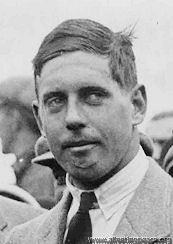
  Capt Edgar Wikner Percival

  1930, aged 32


Australian aeronautical genius who ended up in the USA and New Zealand, via Luton.

b. 23 Feb 1897 in Albury, N.S.W. In 1915, while training in England, he became only the third person on record to recover from a spin (supposedly, Fred Raynham [q.v.] was the first). He later wrote: "After that I found that spinning was great fun and spun a Bristol Scout the next day. Very much later, on the Western Front, I found a spin was a very speedy way of dropping on the enemy - especially through a handy cloud."

Designer, and pilot, of some of the finest racing and record-breaking aeroplanes of all time.

"He always flies his rakish Mew Gulls in a soft felt hat and tries to look as much unlike an intrepid birdman as possible, though he has never yet deceived the handicappers by this ruse." 

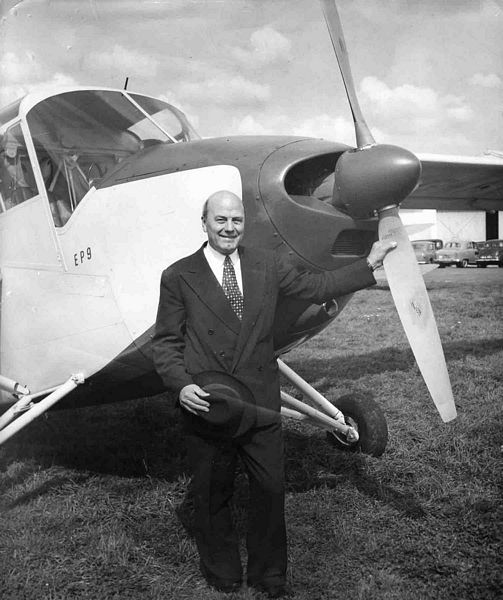
  King's Cup 1934; sans trilby, for once
Flight said he "has an uncanny navigational sense in thick weather, but sometimes flies pensively past his destination in 100-mile visibility".

Michael Madigan wrote: "It was very difficult to resist his puckish humour and not to fall under his spell... In his early flying days he had a fox-terrier called Ginger Mick. This dog always sat in the [open] rear cockpit tethered to a spar. One day as Edgar was preparing to land he went into a loop to lose height, forgetting about his passenger. After levelling off he heard strange scrabbling noises from the back and looking out saw Ginger Mick frantically dog-paddling in the air suspended by his lead. Edgar managed to manoevre Ginger back into the plane, and after landing he thought he would never see Ginger Mick again as he rushed off, but Ginger was as persistent an aviator as his master and reappeared, to settle in his place at start-up, large as life, and eager for more."

 In 1956, with the EP.9 'Prospector'. And trilby.

© The Royal Aero Club


d. 21 Jan 1984; his ashes were taken by the RAAF "to be scattered in the very field in Richmond, N.S.,W., where it all began."

"Edgar Percival had a strong character, a high mental and moral sense, and was a perfectionist - the qualities which made him successful. He was the dominant presence which compelled attention in a group. This dominance arose from his vast knowledge of aviation in all its aspects... all this and his strength of will did not make him an easy associate. He could see problems clearly, had the energy to solve them, and drove himself relentlessly, which made him rather intolerant of those less gifted."

(All quotes via Martin Barraclough, for which many thanks)


Details
Hits: 3081


  Lieut C RV Pugh, RN


 ??


Details
Hits: 3179
  Sqn-Ldr (later Wing-Cmdr) James Milne Robb GCB KBE DSO DFC AFC


photo: 1916, when a Captain in the 4th Northumberland Fusiliers, aged 21


photo: 1944, aged 49


from Northumberland. RAF during WWI, then Iraq and Kurdistan. Chief Flying Instructor at RAF Wittering 1927-30.

Later Air Chief Marshall Sir James; WWI ace (7 victories); helped form the Empire Air Training Scheme in 1939; advisor to Mountbatten, Eisenhower in WWII.

d. 1968


Details
Hits: 2802
  Lt Patrick Geoffrey Tremayne Rodd, RN

  1930, aged 29


"He runs a Puss Moth as well as a Speed Six Bentley. He is probably unique, in that he has had his chauffeur, Mr. J. Camp, taught to fly at the Hanworth Club, so that he can have either his aircraft or his car brought to him when he requires them. He does a great deal of Continental flying..."

He was killed 31 Jan 1933 when making too 'impetuous' a turn after taking off from a snow-covered lake at St Moritz.

A 'good natured, wealthy young pilot'. And his 1919 diaries are in the National Archives.


Details
Hits: 3293
  Hon Walter Leslie Runciman OBE AFC


photo: 1928, aged 28


2nd Viscount Runciman of Doxford, from Newcastle-upon-Tyne; after Eton and Cambridge, joined his dad's shipping firm, then Imperial Airways. First Director-General of BOAC, Commodore of the Royal Yacht Squadron, OBE, etc, etc; died 1989

His sister, Margaret Fairweather, was killed in WWII serving in the ATA. See 

https://www.ata-ferry-pilots.org/index.php/category-blog-1940/81-fairweather-margaret-mrs


Details
Hits: 2871
  F/O Phillip Edward Gerald 'Gerry' Sayer

 mini_-_p_e_g_sayer.jpg


 The first British pilot to fly a jet fighter, in 1941; killed in 1942 in a flying accident in Northumberland.


Gerry Sayer - Wikipedia


Details
Hits: 4707


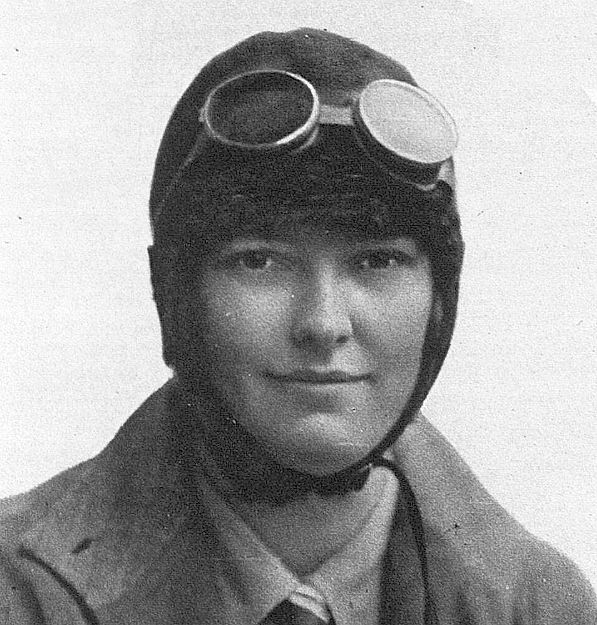
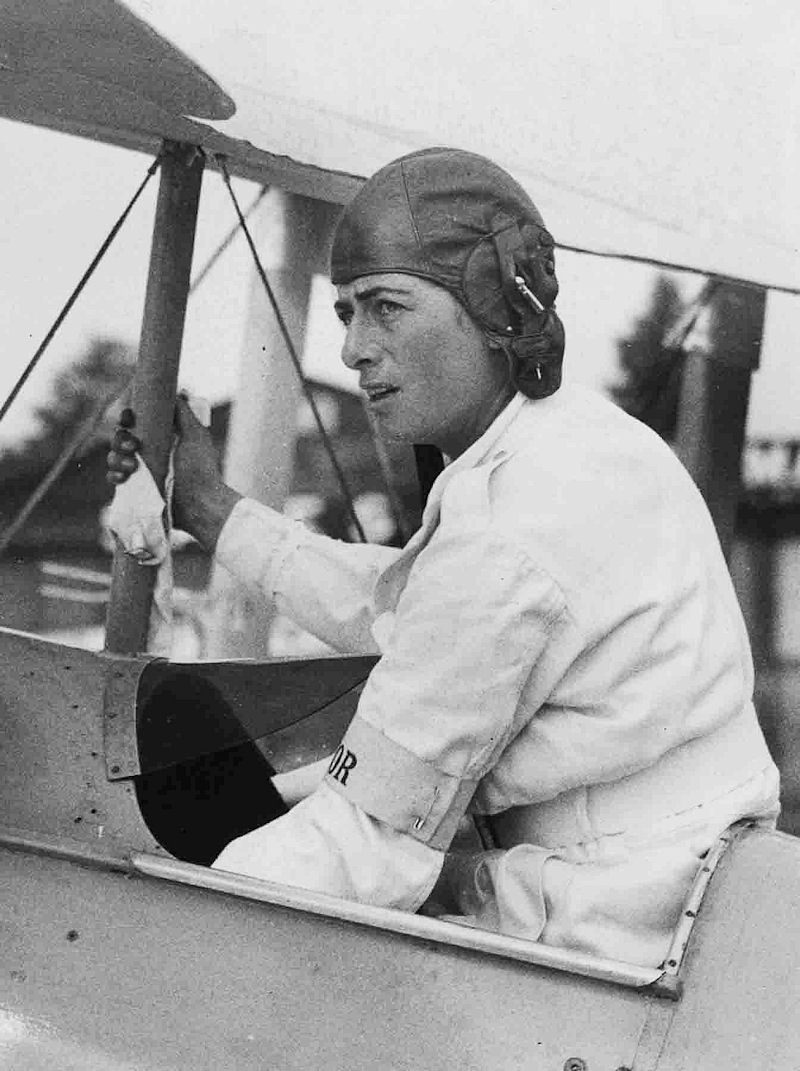
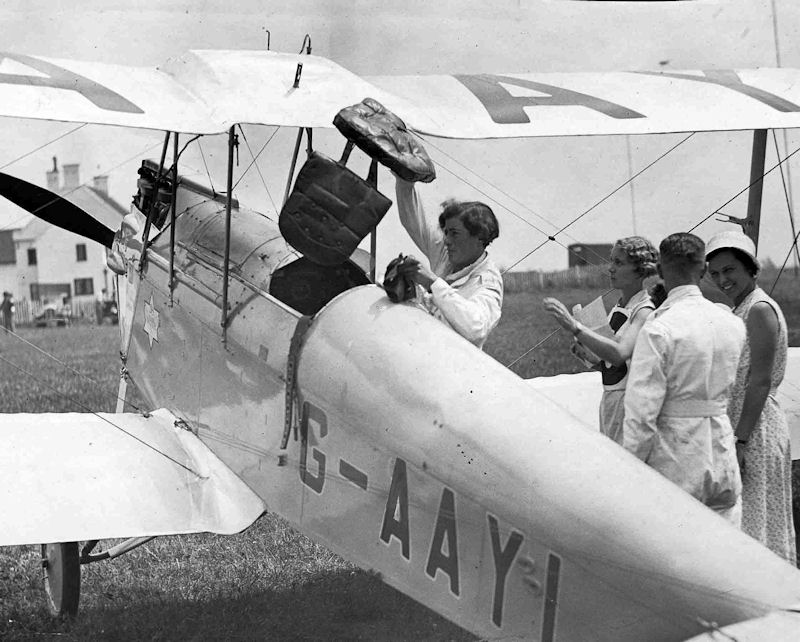
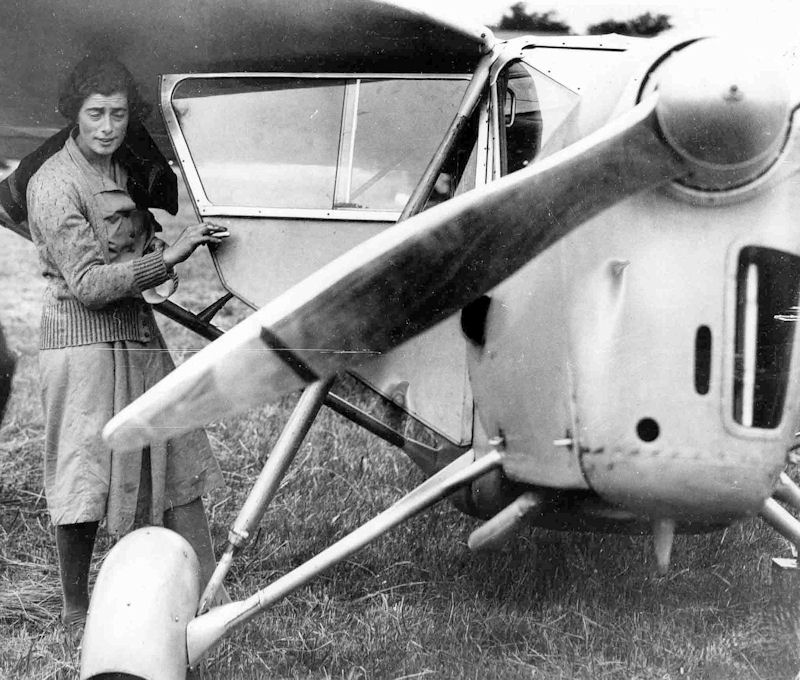
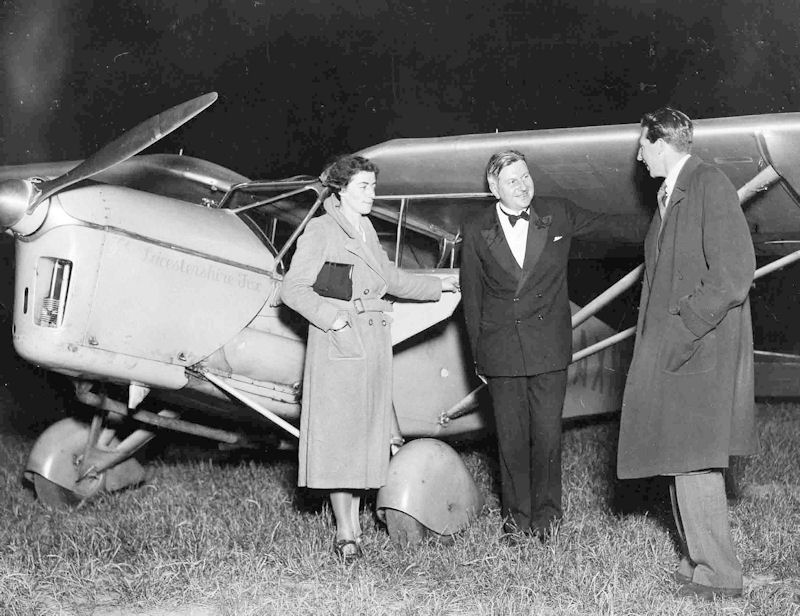
 Miss Winifred Evelyn Spooner

Royal Aero Club Certificate No. 8137 (11 Aug 1927) 
   1927, aged 27 Winifred_Spooner.jpg 
  

'Bad luck Wimpey' was one of the best-known women aviators of the time, and the one generally regarded as the best. She was awarded the International League of Aviation's Trophy for women aviators in 1929, and in 1930 Capt C D Barnard described her as 'the finest woman pilot in the world' (He went on to say that Lady Bailey was regarded as the 'second finest airwoman in the world', and we don't know what she thought about that...)

Learnt to fly in 1926 and took it 'more seriously than most' - in her first race in April 1928, she won the Suffolk Handicap (21 miles at 78mph), ahead of Neville Stack and four other male rivals; she won the 'heavy' category in the Round Europe Contest for Touring Aircraft in 1930 - covering 4,700 miles at 102mph, ("a very fine performance indeed", said The Times) and also competed in the Ladies event at Reading (May, 1931) -  the other competitors were Amy Johnson, Grace Aitken, Pauline Gower, Dorothy Spicer, Susan Slade, Gabrielle Burr, Christina Young, and Fidelia Crossley - a historic gathering indeed.

Photo here

Winifred Spooner2    Winifred Spooner4

She soon took her 'B' (Commercial) Licence, and at one stage was the only professional woman pilot in the country.

In September 1927 her first flight abroad was to Venice to support the British Team in the Schneider Cup in Venice. Alan Butler (with Peter Hoare as passenger), and Hubert Broad, who took Maia Carberry, also went and, in case you were wondering, "Mrs. Carberry wore a pale blue leather flying helmet to match the colour of her Moth aeroplane."

She soon became regarded as 'one of the few women who matter in the air world'; in March 1928, when King Amanullah of Afghanistan was on a state visit to London, he inspected "the latest types of Imperial Airways passenger machines and a number of small Moth machines in private ownership. He carried on, through an interpreter, an animated conversation with Miss Winifred Brown, of Manchester, and Miss Spooner, of London, both of whom own and fly small two-seater machines."

In the 'Woman's World' section of the Inverness Courier of April 1928, this description of Winifred appeared: "[she] has not flown for very long, for it was only about three years ago that I knew her in Cologne, when she then drove, instead of an aeroplane, a two-seater car, through the crowded streets of Cologne, at a speed which most people would have been terrified to attempt. She was always, however, extremely cool and composed, and though her passengers were sometimes nervous she never seemed so. She was always very sporting, and played an excellent game of tennis. A good-looking, typically English girl, she made many friends among the British army in Cologne when doing voluntary work with the Y.M.C.A. there. [Winifred was with the 'Army of Occupation' in Germany at the time]"

She did have what she later described as her 'greatest air thrill' on Marlborough Common in May 1929; "she had been taking passengers up all day when, after one flight, she said she was not quite satisfied with the controls, and refused to take the next man until she had attended to the aeroplane. After doing so she started the propeller, and as she walked away from it the machine suddenly moved forward. Pluckily, Miss Spooner jumped and caught hold of the wing, her idea being to clamber into the cockpit and stop the engine. The machine quickly gathered speed, and she was dragged 40 or 50 yards [she later reckoned it was about 30 yards], when to the horror of the crowd the plane turned and buried its nose in the ground, hurling Miss Spooner some distance. She was unconscious. Doctors were sent for and she was taken to hospital. 'We thought she must have been killed,' an eye-witness told our representative."

She was taken to Savernake Hospital suffering from a sprained wrist, cuts, and slight concussion.

She does seem to have had quite a few run-ins with the local Constabulary; firstly in January 1929 for failing to keep her Alsatian dog under proper control (it had attacked another dog which "had no chance"), then in August 1929 for failing to produce a car driving licence (she said she had forgotten about it and flew to France the following day); then in 1931, she was fined £35 for leaving her motor car unattended and for failing to have lights on it. When she was told that she would be reported, she said: "I am used to it." A police-superintendent said there were no previous convictions recorded against her, as far as Reading was concerned. The Chairman then asked 'And none in the air? She replied 'There are no policemen in the air. That is why I like it.'"

I'm certainly sorry I missed her talk, given in April 1928 at Harrods in Brompton Road, on "Flying as a New Delight for Womankind".  Later, in the early thirties, she wrote for "Good Housekeeping" on, of course, "Flying for Women", alongside such luminaries as John Galsworthy, Kate O'Brien, and Hugh Walpole.

September 1929 saw her accompanying NFS's chairman Freddie Guest (q.v.) to Nairobi, to inaugurate an air taxi service and give flying lessons. They took 3 aeroplanes with them, and flew them back (via South Africa) in February 1930.

She and E C T 'Cecil' Edwards tried to fly a Desoutter to Cape Town and back in December 1930, but this expedition ended up in a forced landing in the sea off southern Italy; Cecil and Winifred had to swim a couple of miles to shore.

Mary_Amelia_Amy_Winifred

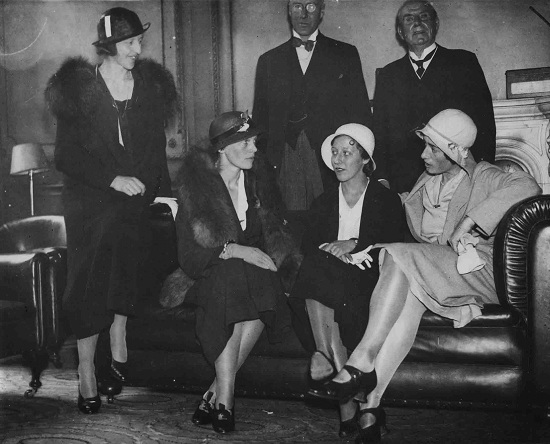
She regularly competed in the King's Cup - coming 3rd in 1928 - and was a guest at Amelia Earhart's reception at the Royal Aero Club in May 1932.

Winifred Spooner3    Winifred Spooner Lindsey Everard

She was personal pilot to Leicestershire M.P. Lyndsey Everard from February 1931 - they are seen here with Nigel Norman.

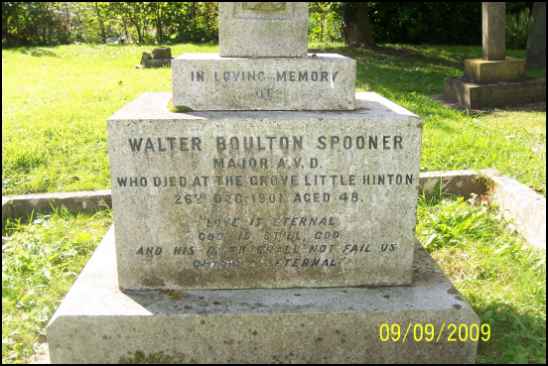
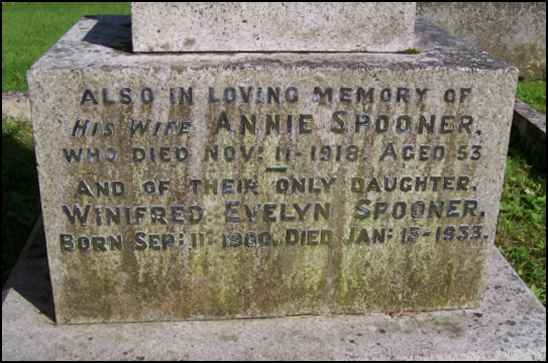
And then, suddenly, on 13 January 1933, she was dead - not in an air crash, but as a result of a cold which rapidly worsened into pneumonia. Only few days before, in conversation with a friend, she had mentioned that her mother had died from influenza in 1918. "The deaths of both mother and daughter occurred with the same suddenness."

They are buried together in Hinton Parva: see http://www.earlyaviators.com/espoone5.htm

spoonermonumentwalter    Winifred E. Spooner

She left £1,357 0s 8d, and her brother, Capt. Frank Vivian Spooner, Indian Army (retd) was appointed administrator. She hadn't got round to writing a will.

There is a scholarship in her memory at Sherborne School for Girls.

"In the passing of Winifred Spooner the world has lost a great woman... she stood out as a woman of indomitable courage".
 

Winifred owned:

a 1926 DH.60 Moth (G-EBOT),

a 1928 DH.60G Gipsy Moth (G-AAAL, which she sold to Elise Battye);

a 1930 Desoutter IID (G-ABCU - this is the aeroplane she and E.C.T. Edwards ditched in the sea off Naples in December 1930), and later

a 1932 Breda 33 (G-ABXK), which was sold in Italy just 3 months before her death.

Winifred's brother Tony was chief flying instructor at the Montreal Flying Club in 1931. He was killed in March 1935 in Egypt when piloting a D.H. 84 Dragon, SU-ABI belonging to Misr Airwork, when it was caught up in a sandstorm and both engines failed.


Details
Hits: 3061
  Mr Arthur John Graham 'Bill' Styran

  1921


b. 28 Jul 1890, Londonderry, Ireland but lived in England from 1891

Royal Field Artillery Lt, then RAF in WWI

m. 1921 Violet [Mitford] in Morpeth, Northumberland:

 Ancestry.co.uk

2 October 1933: "The recent tragic sequence of British air accidents was continued yesterday by two crashes, costing four lives. The more serious occurred near Hawkhurst, Kent, when disaster overtook a private 'plane returning from the R 101 unveiling ceremony at Allonne. The machine crashed at a terrific speed out of dense mist into a field.

The three occupants, who were killed instantly, were:— CAPTAIN A. J. STYRAN, the pilot; MR lAN C. MACGILCHRIST, of Montpellier Street, W., chairman of the British Air Navigation Co., owners of the 'plane; and MR BERTRAM WILSON, a press photographer, returning with pictures he had taken of the memorial service. Visibility was very poor, and with no eye-witnesses and no survivors, the cause cf the accident remains a mystery. By coincidence, Mr Frank Crouch, stockman, at Old Place Farm, who was the first to reach the wreckage, witnessed the passing over of the ill-fated R 101 when she left for India."

"Capt Styran was the winner of the London-Cardiff Race this year"

"A FINE FLIER. A friend of Captain "Bill" Styran, who was killed in the air crash his way back from Beauvais at the week-end, tells me that "Bill " was the very best type of pilot for civil flying. He never took unnecessary risks and his services were in great demand among business men who wished to make extensive air tours. He had recently returned from such a trip in Russia. " Bill " was tall and well built, though he carried on his face the scars of a previous crash."


Details
Hits: 3395
  F/O Sidney Albert 'Bill' Thorn

  1930, aged 29

  1947, aged 46

 Joined the RAF in 1925 (RAE Farnborough from 1927) after a stint in the Coldstream Guards followed by poultry farming in Surrey, then took over from Neville Stack (him, again) as chief test pilot for the Aircraft Disposals Company.

Charter pilot at Brooklands; sometime middleweight and light-heavyweight boxing champion, and a major in the Home Guard. Avro's test pilot from 1934.

Killed in the prototype Avro Tudor, (together with chief designer Roy Chadwick), on 23rd August 1947.

[With thanks to John Falk, who is Roly's (q.v.) son, and Bill Thorn's grandson]


Details
Hits: 3100
  Mr Francis Robert Walker

  1930, aged 20


 an accountant from Bayswater


Details
Hits: 2851
  Hon Richard Westenra

 mini_-_h_r_westenra.jpg 1925, aged 32


Lady Mary Bailey's brother

[m. 1919

The Hon. Alice Florence [Blacker-Douglass], from Devon but b. Dublin 20 Jan 1895; owned a 1929 DH.60G Gipsy Moth, G-AAJZ.]

 with daughter Cynthia, 1924 - The Tatler
 

Wednesday 11 March 1936: "The Hon. Richard Westenra, brother of Lord Rossmore, was respondent to his wife's petition before Sir Boyd Merriman in the London Divorce Court yesterday and co-respondent in another suit In the first of the two connected suits.

Mrs. Allies Florence Westenra (nee Blacker Douglass). of Seafield, Millbrooke. Jersey, sought a decree nisi against the Hon. Richard Westenra on the grounds of his misconduct at a Brighton hotel in February, 1935, with Mrs. Margaret Cecilia Suliven Hope. The suit was undefended."

Richard d. 1944. Lady Mary was at his funeral.


Details
Hits: 2947
  Sqn-Ldr (later Wing-Cdr) John Whitaker Woodhouse

  1930, aged 42


from Devon; pre-WWI, a well-known car and motor-cycle racer. A member of No. 4 Squadron in WWI, he was the first pilot to land a spy successfully behind the German lines, and was also lost over the North Sea for several hours after having attacked and driven off a Zeppelin.

In 1931, he was in command of No. 207 (Bombing) Squadron at Bircham Newton.